Looking back, I don’t remember when our friendship began. I remember what we held.
Hours together. Long, unhurried conversations. Our thoughts, our fears, our unguarded selves held between us. We laughed until we cried. We cried until it passed. We called it solving the world’s problems…
That conversation lasted nine years.
It wasn’t uninterrupted.
There were disagreements. Pauses. Quiet stretches.
But we’d find our way back to each other.
Our differences were rooted in the very core of who we were.
She was soft and smushy, like a warm, fuzzy blanket you reach for without thinking, gentle and absorbing. I had harder edges, more like a stiff wind or a bare tree in winter… direct, exposed, a little sharp.
She was comfortable sitting quietly in the middle of things. I moved fast.
She let her thoughts take their time, turning them over carefully before speaking. I spoke quickly and deliberately, my words often flying out before I’d fully sanded them down.
She wanted reflection.
I wanted resolution.
We were different.
And deeply connected.
Those differences didn’t weaken us: they gave our friendship its shape, something we learned to hold rather than smooth away.
We met while living in the same neighborhood, both of us deeply involved in community happenings. I was everywhere – committees, meetings, events – neck-deep in the life of the place. Trying to fit. From the outside, it looked like I belonged completely. But I never felt it… not fully, not in my bones.
Some places never quite settle into you.
She, on the other hand, belonged. The neighborhood fit her, held her. Loved her. She was rooted there in a way I never was. We talked about it often. For me, being there felt like too much to hold. For this and so many other reasons, my husband and I decided to move.
Around the same time, she told me her body was changing in quiet but unmistakable ways. Her words came more slowly. Her energy thinned. She tired more easily…
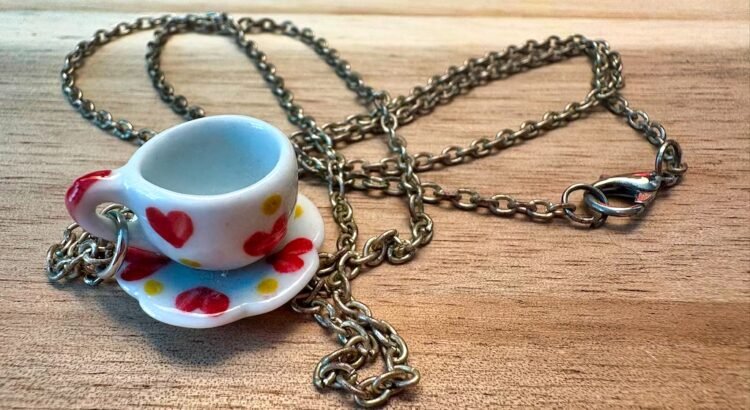
I gave her a tiny teacup charm, a way for me to stay with her when I couldn’t be there. Think of your energy like this little cup, I told her. Precious. Finite. Worth protecting. She slipped it onto a gold chain and wore it often. Something that might remind her of me when days were hard.
And then everything changed.
Because shortly before I moved, I betrayed a confidence and told her secret. It was too heavy to hold. Too important to keep.
She ended our friendship.
I knew the cost.
I paid it anyway.
Two months later, as we drove away for the last time, my husband asked, Did we leave anything behind?
I stared out the window at houses sliding past, familiar yet already beginning to feel foreign.
I left behind a cherished friendship, cut off mid-sentence.
I left behind a trust I knew could not be repaired.
And a silence I helped create.
Oh my God, yes… I did leave something behind.
I left behind someone who believed I had failed her.
I didn’t try to correct her.
Some things are just never meant to be secrets…
What followed me to our new home wasn’t just furniture and boxes, but the grief of a friendship I believed was gone for good. I accepted that ending. Which is why, when she reached out eighteen months later, it felt like something lost forever had found its way back to me.
She said that despite the breach of trust, she was afraid of one thing only: ignoring her heart and regretting it forever.
She didn’t want to let go.
Neither did I.
We picked things back up. Met each other where we were.
In short time, the distance between us began to close through long, careful emails. Patiently, we talked our way back through what had happened. Then caught each other up and began to move forward.
But during our silence, her life had shifted. Her speech, strength, and ease of movement had been stolen. Tests and specialists crowded her days as doctors searched for an explanation. By the time ALS was finally diagnosed, she had already been living with symptoms for over two years.
I understood enough to feel time pressing in.
I returned for a several visits and we continued the conversation we had been having for years. When the disease stole her voice, she refused to be silent and found a digital one. It slowed our exchanges as she typed… but the pauses asked something of us, changing how we listened.
Our time, like the energy in her teacup, was quickly waning.
Months later, I was diagnosed with an aggressive cancer. I yearned to talk with her, to share the language of life-altering illness with someone who understood it.
About the thoughts that drift in and out.
About the possibility of leaving this earth.
About fear… and hope.
But she didn’t want to talk about the gravity of her disease, or mine.
She refused to put words to it.
I desperately sought them.
We reached an impasse, each of us facing the same moment from opposite sides. My emails, heavy with questions, reality, and sharp with urgency, overwhelmed her. Hers, filled with small talk, denial, and local news, left me screaming for something deeper.
Frustration thinned our words.
Messages grew shorter, then seldom… hard to write, harder to read.
Looking back, I think we reminded each other too much of illness… of the vulnerability neither of us could bear. By summer’s end, we were both worn hollow, each fighting our own war, with nothing left to offer the other.
The strain was too deep.
We called it stepping back.
But it was leaving.
And this time, we both knew.
We didn’t speak again.
In short time, things got better for me as I healed.
But much worse for her.
A week before Christmas, her husband died, unexpectedly, cruelly, and quickly, from a cancer that offered no warning and little time.
My heart broke when I heard that.
I couldn’t imagine those final months for her: the loss of her voice, the loss of her husband, the loss of her independence… all inside a body that was rapidly failing her.
I sent a card, but knew I wouldn’t hear back.
She was already holding too much.
And her teacup was nearly empty.
Weeks later, her ALS had advanced with such speed that the end was no longer abstract. She faced what was inevitable with courage and intent, making deliberate choices about how it would come.
She left this world at home, surrounded by those dear to her, their hands holding hers as she took her final breath. She died knowing she mattered. On Valentine’s Day. Even in her leaving, she chose love… just as she always had.
I’m relieved I wasn’t there.
And I’m angry I wasn’t.
More than anything, I’m devastated that our last goodbye was shaped by sickness and strain.
I loved her.
I know she knew that.
But I hate that this needs to be enough.
She was cremated on my birthday.
Just before she died, I’m told she laid out her jewelry and other trinkets, inviting friends to choose what they wanted. On the day she left, the teacup charm was still sitting on the counter. A dear friend took it on my behalf.
That teacup had found its way back me.
Whether or not they exist, I tend to look for lessons.
Her friendship taught me that love is far more complicated – and far more durable – than I’d ever believed.
Ironically, she would have loved that.
It also taught me that love and protection are not always the same thing.
That not all betrayals are born of carelessness.
That compatibility is not sameness.
That illness changes the language of love.
That closure is not something you earn by doing everything right.
That love doesn’t disappear just because the conversation ends.
Mostly, I learned that love doesn’t require a perfect ending to be real.
Like the teacup, we are not meant to hold everything.
But we are meant to hold what we can… tenderly and honestly, until it’s time to set it down.
I did that.
And the fact that it still hurts is not evidence of failure.
It’s evidence of love.
Sleep sweetly, my dearest friend….
This post ©2026 ORANGESWING.COM AND SUSIE RILEY.
ALL RIGHTS RESERVED.